
Sleep
Sleep in perimenopause: night sweats, insomnia, and the apnoea nobody mentions
8 min read · Updated 27 June 2026 · 10 sources
In short
Waking at three every morning is one of the most common complaints of the transition, and it has at least three different causes that need different answers. Here is how to tell them apart.
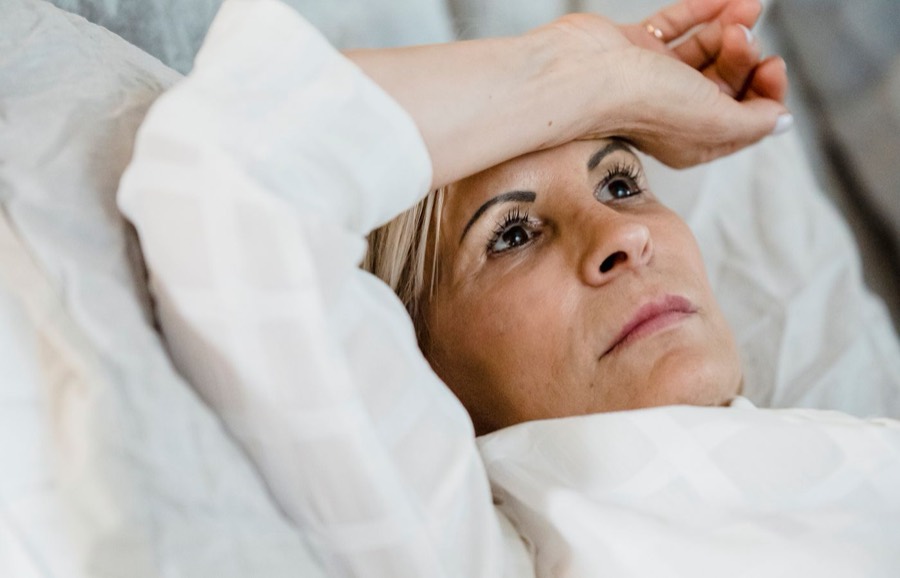
You fall asleep fine. You wake at three, damp and wide awake, and then you lie there for ninety minutes doing arithmetic about how tired you will be tomorrow. By seven you are asleep again, and by seven fifteen the alarm goes.
This pattern is close to the signature complaint of the menopausal transition. The NHS lists sleep problems among menopause and perimenopause symptoms and notes they may be worse if you also have night sweats 5. It is also not one problem. Sorting out which of the plausible causes is driving it changes what actually helps, which is why a good sleep conversation with a clinician takes longer than you expect.
How common, and how severe
A large share of women report sleep difficulties approaching menopause and beyond. In the review most often cited on this, around 26% have symptoms severe enough to affect daytime functioning and meet criteria for insomnia 1.
Two findings from that review are worth holding on to.
First, longitudinal population studies show that sleep difficulties are linked to menopausal stage and to changes in FSH and oestradiol over and above the effects of age 1. This is not simply what happens to everyone in their late forties.
Second, hot flushes are a major contributor but not the whole story. Many, although not all, hot flushes coincide with awakenings measurable on polysomnography, and the wake time attributable to them contributes significantly to total wakefulness after falling asleep 1. Some women have badly disrupted sleep with no vasomotor symptoms at all.
The three things it usually is
Night sweats waking you
If you wake hot, throw off the duvet, and settle once you cool down, the sleep problem is downstream of the vasomotor symptom. In that pattern, the sleep problem follows the flushes.
NICE recommends considering menopause-specific CBT as an option for people who have sleep problems such as night-time awakening in association with vasomotor symptoms 3. Note the framing. The CBT is offered for the sleep problem, in the context of the flushes.
Insomnia in its own right
Insomnia is a distinct condition with its own treatment, and it can be triggered by the transition and then keep running under its own momentum. The NHS defines it as regularly finding it hard to get to sleep, waking several times, lying awake, waking early and being unable to return to sleep, or still feeling tired on waking. Under three months it is short-term insomnia; three months or longer is long-term insomnia 2.
The NHS is clear about the treatment order. Sleeping habits first. If that has not helped, see a GP, who will look for a cause and may offer cognitive behavioural therapy, either face to face or as an online self-help programme 2. GPs now rarely prescribe sleeping pills, which can have serious side effects and can create dependence, and when prescribed they are for a few days or weeks at most 2.
The NHS says over-the-counter sleep aids containing valerian, lavender or an antihistamine cannot cure insomnia and are not meant to be taken for longer than one to two weeks 2.
Sleep apnoea, which gets missed
This is the one that goes undiagnosed, and it deserves its own paragraph.
Sleep-related breathing and movement disorders become more prevalent after menopause 1. The classic picture that gets a man referred for a sleep study, loud snoring and witnessed gasping, is not the way it always presents in women, who may instead report fatigue, insomnia or low mood. Diagnosis requires a sleep study.
The NHS route is that you may be referred to a sleep clinic if you have symptoms of another sleep disorder such as sleep apnoea 2.
The practical consequence: if you have been treating years of broken sleep as a menopause symptom and nothing has helped, sleep apnoea is a question worth putting on the table directly.
Sleep hygiene, without the woo
The NHS list is short, unglamorous and evidence-based. Go to bed only when sleepy. Get up at the same time every day. Wind down for at least an hour before bed. Keep the bedroom dark and quiet. Exercise during the day. Make sure the mattress and bedding are comfortable 2.
The corresponding do-nots: no smoking, alcohol, tea or coffee within six hours of bed; no large late meals; no exercise within four hours of bed; no screens right before bed; no daytime naps; and do not sleep in after a bad night, but stick to your usual hours 2.
Two things worth saying about what is not on the list. The evidence for cooling techniques and relaxation as treatments for vasomotor symptoms specifically is graded as not recommended by The Menopause Society 8. That does not mean a cooler bedroom is a bad idea; the NHS recommends a dark, quiet room, and comfort is its own justification. It means a fan has not been shown to reduce the flushes themselves.
What hormones do and do not do for sleep
The Menopause Society's 2022 review notes that sleep disruptions are strongly associated with vasomotor symptoms, and that hormone therapy in the form of low-dose oestrogen or progestogen may improve chronic insomnia in menopausal women, with 14 of 23 studies reviewed showing positive results 4. It also notes some evidence that transdermal oestrogen therapy may benefit sleep in perimenopausal women independently of vasomotor symptoms 4.
There is a detail here that surprises people. Oral micronised progesterone has mildly sedating effects, reducing wakefulness without affecting next-day cognitive function, possibly through a GABA-agonist effect, and the review says it should therefore be given at night 4.
For anyone taking progesterone as part of HRT, timing is a question for the prescriber rather than something to change alone.
Why it matters beyond feeling tired
Poor sleep in midlife is not only unpleasant.
Poorer sleep quality has been associated with mood changes, memory problems, metabolic syndrome, obesity and other cardiovascular risk factors, and short or very long sleep duration, poor sleep quality and insomnia have been associated with greater cardiovascular disease risk 4. The American Heart Association's statement on the menopause transition reports that objectively measured poorer sleep quality has been associated with greater risk of metabolic syndrome and with carotid plaque and intima-media thickness, and that shorter sleep duration, poorer sleep quality and greater insomnia severity were associated with worse cardiovascular health scores in postmenopausal but not premenopausal women 6.
There is a cognitive link too, and it is more specific than "tiredness makes you forgetful". SWAN found that during the menopause transition itself, self-reported sleep and hot flushes were not associated with decrements in memory or processing speed. In early postmenopause, however, women with greater wakefulness and sleep fragmentation scored lower on cognitive processing speed 7.
These are associations from observational research. They do not establish that fixing sleep fixes the risk. They are a reason to take the sleep complaint seriously rather than filing it under things to endure.
Guidance in the US and Europe
Neither of the main insomnia guidelines is specific to menopause, but both apply to chronic insomnia whatever its cause.
In the US, the American Academy of Sleep Medicine strongly recommends multicomponent cognitive behavioural therapy for insomnia (CBT-I) for chronic insomnia in adults 9. The European Insomnia Guideline, updated in 2023, recommends CBT-I as the first-line treatment for chronic insomnia in adults of any age, delivered in person or digitally, with medication offered when CBT-I is not effective enough 10. It does not recommend antihistamines, fast-release melatonin or herbal remedies for insomnia 10.
What is still uncertain
The relative contribution of hormonal change, vasomotor symptoms, mood, ageing and behaviour differs from woman to woman, and the review that gathered this evidence calls the basis of these sleep difficulties multifactorial for exactly that reason 1.
Whether treating insomnia in midlife changes long-term cardiovascular or cognitive outcomes has not been established. The evidence that severe untreated insomnia has consequences beyond quality of life is described as emerging 1.
When to see a clinician
The NHS suggests seeing a GP if changing your sleeping habits has not helped, if you have had trouble sleeping for months, or if it is affecting your daily life in a way that makes it hard to cope 2.
Heavy snoring, being told you stop breathing in your sleep, waking with a headache or dry mouth, or feeling sleepy during the day despite enough time in bed can all point towards sleep apnoea. The NHS notes that a GP may refer you to a sleep clinic if you have symptoms of another sleep disorder 2.
The NHS also advises against driving when you feel sleepy 2.
If low mood or anxiety is part of the picture, it belongs in the same conversation. Sleep complaints in midlife are sometimes comorbid with depressive disorders 1, and untangling the two is part of the assessment.
Two weeks of notes beats a paragraph of impressions
Sleep is one of the few midlife symptoms where a short written record changes the conversation immediately, because the useful facts are countable: what time you went to bed, roughly what time you woke, whether you woke hot, how long you were awake, and how you felt the next day.
Fourteen lines in a notebook is enough to tell a clinician whether you have a sleep-onset problem, a maintenance problem or a breathing problem. Halcyon records sleep quality alongside symptoms if you would rather do it on a phone, but the notebook works.
Bring this to your appointment
Tick the ones you want to ask, then print. Only ticked questions print.
Sources
- Baker FC et al. Sleep problems during the menopausal transition: prevalence, impact, and management challenges. Nat Sci Sleep 2018.
- NHS. Insomnia.
- NICE guideline NG23. Menopause: identification and management. Recommendations.
- The 2022 hormone therapy position statement of The North American Menopause Society.
- NHS. Symptoms of menopause and perimenopause.
- El Khoudary SR et al. Menopause transition and cardiovascular disease risk. AHA scientific statement. Circulation 2020.
- SWAN. Fact sheet: memory and cognition during and after the menopause transition.
- The Menopause Society. 2023 nonhormone therapy position statement.
- Edinger JD et al. Behavioral and psychological treatments for chronic insomnia disorder in adults: an American Academy of Sleep Medicine clinical practice guideline. 2021.
- Riemann D et al. The European Insomnia Guideline: an update on the diagnosis and treatment of insomnia 2023. Journal of Sleep Research, 2023.
General information, not medical advice. It is not a substitute for talking to a doctor, nurse or pharmacist.